What this political compass test measures
Most political quizzes squeeze everything onto one left–right line. That line hides a lot. Two people can both want lower taxes while one wants a strong police state and the other wants the government out of their lives entirely. A political compass test fixes this by adding a second axis, and this one goes further and scores you on four:
| Axis | One end | Other end | What it covers |
|---|---|---|---|
| Economy | Equality | Markets | Taxes, welfare, ownership, regulation, wages |
| State | Liberty | Authority | Policing, surveillance, civil liberties, punishment |
| Society | Progress | Tradition | Family, religion, gender, moral questions |
| World | Global | National | Immigration, trade, sovereignty, aid, defense |
The first two axes give you the classic compass picture: left or right on the economy, libertarian or authoritarian on the role of the state. The other two show what a flat compass misses, such as how you feel about social change and how open you want your country to be.
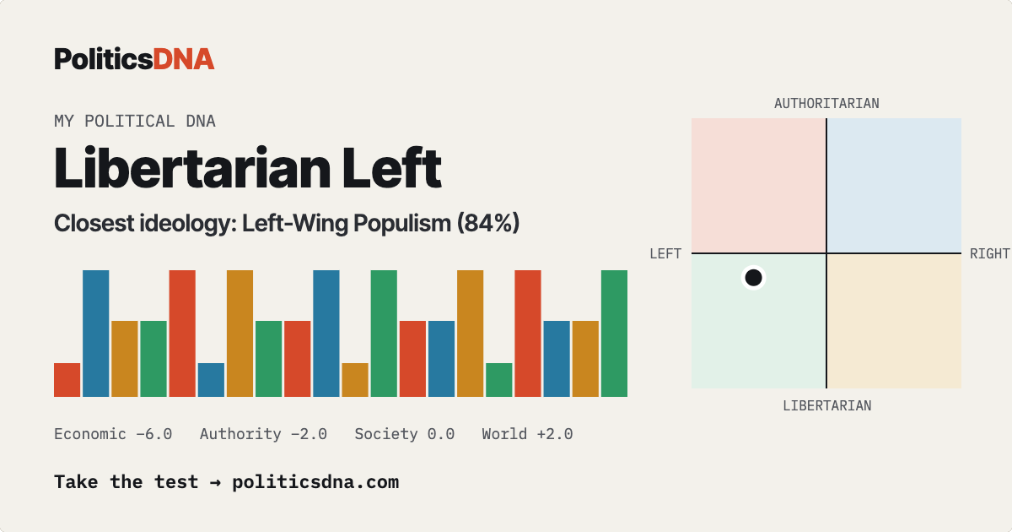
A real result card from this political compass test. The dot shows the compass position; each colored band is one answer.
How the scoring works
Every statement belongs to one axis. Half of the statements on each axis are worded so that agreeing pushes you one way, and half so that agreeing pushes you the other way. That balance matters: people tend to agree with whatever they read, and a test where every statement points the same way rewards that habit instead of your actual views.
Each answer counts from −2 (strongly disagree) to +2 (strongly agree). Your score on an axis is the average push of your answers on that axis, scaled from −10 to +10. Neutral answers count as zero, so a run of neutral answers pulls you toward the center rather than leaving a gap.
You can pick how long the test is:
- Quick, 20 statements. About three minutes. Good for a first look.
- Standard, 40 statements. About six minutes. The default, and the best balance of speed and accuracy.
- Full, 60 statements. About ten minutes. The most stable result, because a single answer moves you less.
You can switch length in the middle of the test. Answers you already gave are kept.
How to read your political compass result
Your result names a quadrant from your two main scores:
- Authoritarian Left. Wants the state to reduce inequality and is comfortable with strong government to do it.
- Libertarian Left. Wants more equality but distrusts concentrated power, whether in government or in big business.
- Authoritarian Right. Favors markets and private property together with order, tradition and a strong state.
- Libertarian Right. Wants both a free market and as little government as possible in personal life.
Scores close to zero on both axes put you in the Centrist zone. Below the quadrant you see your position on all four axes as a percentage lean toward one end. A lean of 20% is mild; anything above 60% is a strong, consistent view.
The ideologies you are matched with
We place 17 well-known ideologies on the same four axes, from libertarian socialism and social democracy to classical liberalism, conservatism and national conservatism. Your result lists the three closest, with a match score based on the distance between your four numbers and theirs. These positions are our own illustrative summaries of each tradition, not official definitions, and real movements always contain a range of views.
Why your result can differ from other tests
Different political tests ask different questions and weigh them differently, so it is normal to land in a slightly different spot on each one. Your result also changes with your mood and with world events. If you want a number you can trust, take the full 60-statement version and answer with your first honest reaction rather than the answer you think you should give.
This test is independent. It is not affiliated with The Political Compass website, any party, campaign or government, and it does not tell you how to vote.
Political compass test questions, by axis
Here is one statement from each axis of the political compass test, and what agreeing with it does to your score:
- Economy: "Key industries like energy and railways should be publicly owned." Agreeing moves you toward the equality end, the left of the compass.
- State: "In an emergency, the government should be able to suspend some normal rights." Agreeing moves you toward the authority end, the top of the compass.
- Society: "Science, not religious teaching, should guide public policy." Agreeing moves you toward the progress end.
- World: "Learning the national language should be required for citizenship." Agreeing moves you toward the national end.
None of the statements has a right answer. Each one is there because people who agree and people who disagree with it tend to differ in a consistent way on that axis.
Tips before you take the political compass test
- Pick the length first. The quick version is fine for curiosity; the full 60 statements give a result that moves less if you retake it.
- Do not overthink a single statement. The test averages many answers, so one hard question will not decide your quadrant.
- Retake it in a few months. Comparing two share cards side by side is a simple way to see whether your views have shifted.
- Compare with a second test. Our political spectrum test uses a different set of statements, so taking both shows how stable your position is.
Sharing your result
When you finish, you get a share card: your quadrant, your closest ideology and a colored strip with one band for every answer. The bands use one color per axis, and taller bands mean stronger answers, so no two people's strips look the same. You can download it as an image or share it straight from your phone.
Your answers stay in your own browser. We do not ask for your name or email to show your result.
Frequently asked questions
Is this political compass test free?
Yes. The test and your result are free, and you do not need an account or an email address to see your result.
How long does the test take?
About three minutes for the quick 20-statement version, six minutes for the standard 40, and ten minutes for the full 60. You can change length during the test without losing your answers.
Is this the official Political Compass test?
No. This is an independent test with its own statements and scoring. It is not affiliated with The Political Compass website, any party or any government.
How accurate is my result?
It reflects how you answered today. Longer versions are more stable because each answer moves you less. Answer with your first honest reaction, and expect small differences between different political tests.
Do you store my answers?
Your answers are saved in your own browser so you can come back to your result. We do not ask for your name or email to show it.
What do the colored bands on my share card mean?
Each band is one of your answers. The color shows the axis (red economy, blue state, amber society, green world) and the height shows how strongly you agreed or disagreed.